Paco Rabanne: The House Built by a Man nicknamed Wacko Paco
Most fashion houses are founded on a vision. Paco Rabanne was founded on a man who genuinely believed he’d lived seventy-five thousand years, met Jesus personally, and been visited by extraterrestrials. He also, by his own account, once murdered Tutankhamun in a past life.
His real name was Francisco Rabaneda Cuervo, born in 1934 in Spain’s Basque region. His mother worked as a seamstress for Cristóbal Balenciaga, and his father was an army general. When the family fled to France in 1939, young Francisco grew up to study architecture in Paris — not fashion. He started his career designing buttons, jewelry, and accessories, work sharp enough that it caught the attention of Christian Dior, Yves Saint Laurent, and Pierre Cardin themselves.
Then, in 1966, he did something almost nobody in fashion had tried: he stopped thinking like a couturier and started thinking like an engineer. He preferred to be described as an engineer rather than a couturier, and it showed — his debut collection was literally titled Twelve Unwearable Dresses in Contemporary Materials, built from metal plates, rhodoid, and rings instead of fabric. He combined hammered metals, pliable plastics, paper, fibre optics, and even cement into garments that looked less like couture and more like something out of science fiction. Coco Chanel reportedly dismissed him as “the metal worker.” He didn’t care. He dressed Jane Fonda for Barbarella, dressed Brigitte Bardot, and decades later dressed Lady Gaga in an outfit made entirely of paper. The nickname that stuck was “Wacko Paco” — and he wore it like a badge.
In 1968, Rabanne signed with the Barcelona-based Puig family, and that partnership built the fragrance side of the house — starting with Calandre in 1969, daringly named after a car’s front grille. It set the tone for everything that followed: Paco Rabanne fragrances were never going to play it safe.
A house obsessed with one idea: victory.
Fast forward to 2013. The house wanted to build something around an entirely different kind of man — not the refined aristocrat Creed had spent centuries crafting, but a completely new masculine ideal: the modern champion. Four perfumers — Véronique Nyberg, Anne Flipo, Olivier Polge, and Dominique Ropion — were brought together to build it. The name they landed on was Invictus, Latin for “unconquered,” and the bottle itself was shaped like a trophy.
The concept ran deeper than marketing. As Rabanne himself put it, Invictus was born from a desire to talk about sport in a new way — by elevating the social fantasy it represents. The fragrance opens with grapefruit and a sharp marine accord, moves into bay leaf and jasmine, and settles into guaiac wood, patchouli, and ambergris — built specifically to evoke the feeling of salt on skin after a win, not just at the beach. It launched alongside a campaign starring rugby player Nick Youngquest walking through a stadium like a modern gladiator, and it worked: Invictus became one of the most recognized, most worn masculine fragrances of the decade, spawning its own “Legend” flanker in 2019.
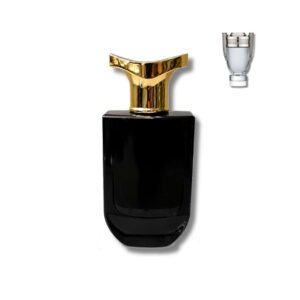
That’s the energy we chased with Aks Titan — that specific cocktail of freshness and quiet dominance that made Invictus a go-to for men who wanted to smell like they’d already won before they walked in the room.