YSL: The House Built on One Unexpected Meeting
Some perfume houses are built on royal warrants. YSL was built on a love story that started at a fashion show.
In 1958, a 21-year-old named Yves Saint Laurent had just taken over as head designer at Christian Dior, following Dior’s sudden death the year before — making him, at that point, the youngest couturier in the world. At one of his early shows, a sharp, ambitious art dealer named Pierre Bergé was sitting in the audience, watching the young designer’s collection land. They weren’t introduced that night. A few days later, at a dinner held in Saint Laurent’s honor, they finally met — and Bergé would later describe it simply: maybe that unexpected thing was love at first sight.
What followed became one of fashion’s most consequential business partnerships. Bergé and Saint Laurent made Morocco their adoptive, and when Saint Laurent was controversially let go from Dior in 1960, Bergé didn’t hesitate. He sold his own apartment in Paris to help raise the money, found a private American investor, and by December 1961, the two of them opened the doors to their own haute couture house under Saint Laurent’s name. Bergé ran the business. Saint Laurent ran the creative vision. It was, by nearly every account, a perfect division of two very different kinds of genius.
That vision changed fashion almost immediately. In 1966, Saint Laurent designed Le Smoking — a tuxedo suit built for women, at a time when that idea alone was an act of quiet rebellion. He’s credited with popularizing the safari jacket, the beatnik look, thigh-high boots — clothes that gave women something Dior’s generation hadn’t: freedom of movement, freedom of attitude. As Bergé put it decades later, looking back on the difference between the two houses he’d known intimately, Saint Laurent didn’t dress rich women — he dressed active women, and let them feel free. That idea — freedom, specifically a woman’s freedom — became something close to the house’s entire philosophy, and it’s still the word at the center of YSL’s most iconic modern fragrance.
A fragrance literally named “Free.”
In 2019, perfumers Anne Flipo and Carlos Benaïm built Libre — French for “free” — around a deliberate contradiction: lavender, a note traditionally used in men’s fragrances, paired against orange blossom, one of the most classically feminine notes in perfumery. That tension between traditionally masculine and feminine materials was the entire point. It mirrored Le Smoking itself — a woman wearing a man’s silhouette and making it unmistakably her own.
In 2024, the same two perfumers returned to Libre to build a warmer, sun-drenched version of it: Libre Flowers & Flames. They kept the signature lavender-and-orange-blossom heart, but folded in something deeply personal to the house’s own history — a desert lily accord, created specifically as a tribute to Yves Saint Laurent’s own favorite flower. Around it, they wrapped a sun-kissed coconut palm blossom note, captured from YSL Beauty’s own community gardens in Morocco’s Ourika Valley — the same region Saint Laurent and Bergé had called home together — and finished it with warm vanilla bourbon. The result reads exactly as intended: floral, but with heat underneath. Free, but unmistakably warm.
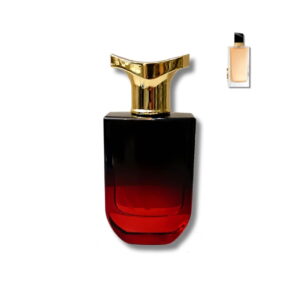
That’s the scent we chased with Aks Untamed F&F — the same lavender-orange-blossom tension, the same sun-warmed, golden-hour vanilla finish that made Flowers & Flames feel less like a flanker and more like Libre fully come into its own.