Victoria's Secret: The Brand Born From a Man's Bad Shopping Trip
Most fragrance houses trace their roots back centuries, to royal courts or Parisian couturiers. Victoria’s Secret’s origin story is a lot more relatable: a man walked into a department store to buy his wife lingerie, and left mortified.
In the mid-1970s, a young entrepreneur named Roy Raymond went shopping for his wife and found exactly what every man of that era dreaded — ugly floral-print nightgowns under harsh fluorescent lights, and saleswomen who made him feel out of place just for being there. Most people would’ve just left with nothing. Raymond, a Stanford MBA, saw a business. If he felt that uncomfortable, other men probably did too — and nobody had built a store designed to fix that.
So in 1977, with $80,000 pulled together from savings and family loans, Raymond and his wife Gaye opened a small shop in a Palo Alto mall. He imagined something closer to a Victorian boudoir than a department store — dark wood, oriental rugs, silk drapery — and he picked the name “Victoria” deliberately, to evoke the prim respectability of the Victorian era. Outwardly refined. Privately, something else entirely. That contrast — proper on the surface, daring underneath — became the whole idea behind the brand, baked right into its name.
Raymond grew the business to six stores and a mail-order catalog within five years, but scaling a national retail brand wasn’t really his strength. In 1982, he sold the company to Leslie Wexner, founder of The Limited, for $1 million. Under Wexner, Victoria’s Secret pivoted to speak directly to women rather than men, and grew into the billion-dollar global name it is today. It’s a bittersweet footnote in retail history that the man who had the original idea didn’t get to see how far it would go — but that’s also, in its own way, very on-brand for an industry full of founders who lit a spark someone else carried forward.
The fragrance that became “America’s No. 1.”
By 2010, Victoria’s Secret had long since become a beauty and fragrance powerhouse in its own right, and that year, perfumers Adriana Medina-Baez and Mark Knitowski set out to build something that captured the brand’s whole attitude in a bottle — confident, a little daring, unmistakably feminine. The result was Bombshell.
It opens with Brazilian purple passion fruit — a fruit from the jungles of Brazil chosen specifically to give the scent a bright, sparkling opening — layered with pineapple, grapefruit, and strawberry. At the heart sits Shangri-La peony, a flower the brand describes as the scent’s true signature note, joined by vanilla orchid and jasmine. It closes on musk, woods, and oakmoss. The whole composition was built around one idea: that every woman has a little bit of bombshell in her, and the right scent should bring it out rather than hide it.
It worked spectacularly. Bombshell didn’t just become a hit — it became America’s number one fragrance, the kind of scent that’s less a niche discovery and more a cultural reference point. Fifteen years later, it’s still one of the most recognized women’s fragrances in the world, the bottle itself instantly identifiable even to people who don’t follow perfume.
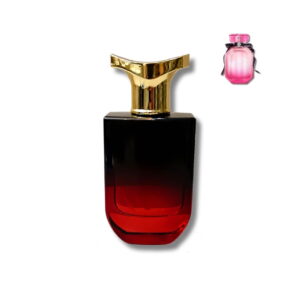
That’s the scent we studied closely for Aks Spark — that same bright, fruity-floral confidence that made Bombshell impossible to ignore in a room.