Gucci: The House That Started With a Bellboy's Daydream
Some fashion empires start with a vision. Gucci started with a teenage bellboy watching rich people’s luggage roll by.
Guccio Gucci was born in Florence in 1881, and as a young man, he left Italy to work at London’s Savoy Hotel — not as a designer, not as a craftsman, but as a porter. Every day, his job was to carry the suitcases and trunks of Europe’s wealthiest travelers up to their rooms. The story goes that watching those aristocrats and their luxurious luggage day after day is what planted the idea in his head — that a Florentine leather worker’s son could build something that beautiful too, if he was patient enough.
He went home to Florence and, in 1921, opened a small shop selling leather goods and luggage on Via della Vigna Nuova. He brought his sons into the business — Aldo, Vasco, Rodolfo, and his adopted stepson Ugo — and the house grew steadily through the decades that followed. When Mussolini’s Italy faced a leather embargo in the 1930s, instead of shrinking, Gucci innovated: the workshop developed a woven hemp material from Naples, which became the brand’s first commercially successful bags, complete with the now-iconic brown diamond pattern. Necessity, turned into signature style. That’s been something of a Gucci pattern ever since.
The house has had its share of real drama too — boardroom battles, family feuds, even, tragically, the 1995 murder of Guccio’s grandson Maurizio, a story dramatic enough that Hollywood eventually turned it into a film. But woven through all of that turbulence is one motif that’s stayed gentle, constant, and almost untouched by the chaos around it: Flora.
A scarf made for a princess, reborn as a perfume four decades later.
In 1966, Princess Grace of Monaco — formerly Grace Kelly — walked into Gucci’s boutique in Milan with her husband, Prince Rainier, and bought a green leather handbag. Rodolfo Gucci, Guccio’s son and the store’s owner, wanted to thank her with something worthy of royalty. She modestly asked for a scarf. Rodolfo felt a plain scarf wasn’t enough for a princess known for her love of flowers — she’d later go on to found the Garden Club of Monaco herself — so he commissioned illustrator Vittorio Accornero de Testa to design something extraordinary: an entire garden of hand-painted flowers, berries, and insects across a single square of silk, in 37 distinct colors. Flowers printed on silk instead of a simple bouquet — that was the gesture. It became known as Flora, and it’s quietly remained one of fashion’s most beloved patterns ever since.
In 2005, creative director Frida Giannini revived the Flora print for a new generation, and the connection wasn’t abstract for her — she’s spoken about watching her own mother and grandmother wear the original Flora scarf when she was a child in the 1970s. By 2009, Giannini took the motif somewhere it had never been before: into a bottle. The original Flora perfume launched that year, built around a bright, sparkling floral character — fresh citrus up top easing into peony and soft osmanthus, with a clean, almost luminous quality that didn’t try to be loud. It was meant to feel like the scarf itself: a garden, captured rather than shouted.
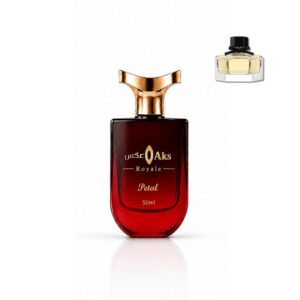
That’s the scent we studied closely for Aks Petal — that same fresh, sparkling, garden-bright character of the original Flora, the version that started a fairy tale’s second act.