Bvlgari: The House Built by a Silversmith Hiding Among Sponges
Most jewelry empires start in a workshop. Bvlgari started in the back of a sponge shop, with a young Greek immigrant quietly displaying his silver pieces among someone else’s merchandise, hoping the right person would notice.
Sotirios Voulgaris was born in 1857 in a remote village in the Pindus Mountains of northern Greece — a region that had been producing master silversmiths since the Byzantine era, the craft handed down father to son for generations. Voulgaris learned it from his own father, then left home in 1877, moving first to Corfu, then Naples, before finally settling in Rome in 1881. With nothing but his skill and a handful of silver pieces, he went into partnership with a Greek sponge merchant, displaying his silverwork among the sponges in their shop on Via Sistina, just steps from where the grand Hassler Hotel stands today. It’s a strange image — fine Byzantine-inspired silver jewelry sitting quietly beside bath sponges — but it worked. Wealthy English travelers on their Grand Tour through Rome started to notice.
By 1884, Voulgaris had enough of a reputation to open his own shop. In 1904, he and his sons Konstantinos and Giorgios opened what would become the brand’s true flagship, on Via dei Condotti — Rome’s most prestigious street, leading straight up to the Spanish Steps. After Sotirios passed away in 1932, his sons gave the house its modern identity: they changed the spelling to the now-iconic “BVLGARI,” using the Latin V instead of the Greek U, and introduced the pink-and-beige Roman marble that still defines the brand’s stores today. By the 1970s, Bvlgari had become a fixture for style icons like Audrey Hepburn, Sophia Loren, and Elizabeth Taylor — a Greek silversmith’s name turned into a symbol of Italian luxury itself.
That’s the throughline that still defines Bvlgari nearly a century and a half later: ancient history, reinterpreted as modern jewelry. And eventually, as perfume.
A perfume built around a gemstone myth.
In 2021, Bvlgari launched Le Gemme — a High Perfumery collection built on a single, almost literary idea: a journey along the mythical “Gems Road,” the ancient trade route that once carried precious stones from the East into Europe, with each fragrance named after — and built around the symbolic meaning of — a specific gem.
For the men’s flagship, master perfumer Jacques Cavallier-Belletrud turned to Tiger’s Eye, a golden-brown stone that fascinated the Ancients with its optical shimmer, and which they called the gemstone “that sees everything” — believed to connect a man to the energy of the earth and sun, granting him mental strength and intuition. The fragrance, named Tygar, was built around that exact duality: a sharp, sparkling grapefruit opening colliding with deep, warm ambergris underneath. It captures the duality and exceptional energies of the Tiger’s Eye itself — bright on the surface, dense and grounded underneath. It quickly became one of the best-selling fragrances in the entire Le Gemme line.
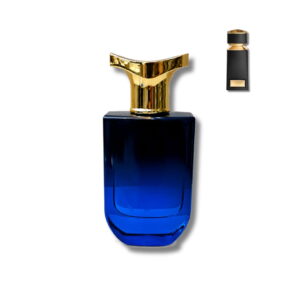
That’s the tension we chased with Aks Regal — that same sharp citrus-meets-deep-amber contrast that made Tygar feel less like a cologne and more like wearing a piece of jewelry.