The Rich History of Attar and Fragrance in South Asian Culture

Long before glass flacons and French perfume houses existed, South Asia had one of the most sophisticated fragrance cultures on earth. Centuries before Chanel or Dior bottled their first perfume, the courts of the Mughal Empire were commissioning bespoke scents from master perfumers, building entire gardens designed to produce aromatic raw materials, and developing distillation techniques that the Western world wouldn’t match for generations.
This isn’t ancient history buried in textbooks. The fragrance traditions born in this region are alive today — in the attar shops of Kannauj, in the oud-burning rituals before Jummah, in the gulab and motia garlands at Pakistani weddings, and in the preferences of millions of people across Pakistan who instinctively reach for warm, rich, long-lasting scents without knowing that their taste was shaped by a thousand years of cultural inheritance.
Understanding this history isn’t just interesting — it’s practical. It explains why Pakistanis prefer base-heavy, long-lasting fragrances. It explains our relationship with oud, rose, sandalwood, and musk. And it connects the perfume you spray on your kurta today to a tradition that stretches back to the Mughal emperors, the Sufi saints, and the ancient trade routes that brought the world’s finest aromatics to the subcontinent.
This is the story of how South Asia became one of the great fragrance civilisations of the world — and how that legacy shapes the way we wear perfume in Pakistan today.
1. Before the Mughals: Fragrance in Ancient South Asia
The use of fragrance in South Asia predates recorded history. Archaeological evidence from the Indus Valley Civilisation (roughly 3300–1300 BCE) suggests that the people of Mohenjo-daro and Harappa used aromatic plants in daily life. Terracotta vessels believed to be early distillation apparatus have been found at these sites, and traces of aromatic residues indicate that plant-based perfumery was practised thousands of years before it became common in Europe or the Middle East.
The Vedic texts, composed between roughly 1500 and 500 BCE, contain extensive references to fragrant substances. Sandalwood, camphor, saffron, vetiver, and various floral materials appear repeatedly in hymns and rituals. Fragrance wasn’t a luxury in Vedic culture — it was woven into religious practice, personal grooming, and medicine. The Ayurvedic tradition classified aromatic substances by their therapeutic properties, creating an early framework for understanding how scent affects the body and mind.
By the time of the great Sanskrit epics — the Mahabharata and the Ramayana — fragrance was established as a marker of refinement and status. Royal courts used sandalwood paste, flower garlands, and incense as essential elements of courtly life. The concept of “solah shringar” — the sixteen adornments of a bride — included scented oils and perfumed body treatments, a tradition that continues in Pakistani and Indian wedding culture to this day.
What’s remarkable about this early period is that South Asia wasn’t borrowing its fragrance culture from elsewhere. While Egypt, Mesopotamia, and the Arabian Peninsula were developing their own aromatic traditions, the subcontinent was independently creating a sophisticated perfumery practice using native ingredients like sandalwood, vetiver (khus), jasmine (motia), and rose (gulab) — materials that remain central to South Asian perfumery today.
2. The Arab Connection: Trade, Islam, and the Arrival of Attar
The arrival of Arab traders along South Asia’s western coast, centuries before the Mughal conquests, created a fragrance exchange that transformed both cultures. Arab merchants brought frankincense, myrrh, and oud (agarwood) from Southeast Asia and the Arabian Peninsula. In return, they carried back South Asian sandalwood, camphor, and spices that would become staples of Middle Eastern perfumery.
This trade wasn’t just commercial — it was cultural. With the spread of Islam into the subcontinent from the 7th century onward, fragrance took on an additional dimension: spiritual significance. The Prophet Muhammad (peace be upon him) spoke of his love for perfume, and applying fragrance — particularly before prayer and on Fridays — became a deeply valued practice. This religious endorsement elevated perfumery from a luxury to a devotional act, embedding it into the daily lives of millions.
The word “attar” (also spelled “ittar”) itself has roots in the Arabic word “itr,” meaning scent or perfume. The technique of hydro-distillation — extracting aromatic oils from flowers and herbs using water and heat — was refined through the exchange between Arab and South Asian perfumers. While the basic principles of distillation existed in both regions, the collaboration produced a method uniquely suited to capturing the delicate scents of tropical flowers like jasmine and rose, which were abundant in South Asia but difficult to extract using cruder methods.
By the time the Delhi Sultanate established Muslim rule across much of northern India in the 13th century, attar production was already a thriving craft. The stage was set for the golden age that was about to arrive.
3. The Mughal Golden Age: When Fragrance Became an Imperial Art
No period in South Asian history elevated fragrance culture more than the Mughal Empire (1526–1857). The Mughals — themselves descended from Central Asian and Persian traditions where perfumery was already highly sophisticated — brought resources, patronage, and personal obsession to the art of fragrance that transformed it from a craft into a high art form.
Babur and the Foundation
The Mughal dynasty’s founder, Babur, was a noted lover of gardens and natural beauty. His memoirs, the Baburnama, describe his appreciation of flowers and fragrant plants, and he is credited with introducing the formal Mughal garden (charbagh) to the subcontinent. These gardens — laid out in geometric patterns around central water channels, planted with roses, jasmine, chameli, and fruit trees — were not just aesthetic spaces. They were living fragrance libraries, providing raw materials for the court’s perfumers.
Akbar and the Institutionalisation of Perfumery
Under Emperor Akbar (r. 1556–1605), the Mughal court became a major centre of fragrance production and innovation. Akbar maintained a large staff of perfumers and established formal protocols for the use of fragrance at court. The daily burning of incense, the use of scented oils during audiences, and the gifting of attars to visiting dignitaries all became institutionalised practices. Agra, Akbar’s capital, developed a significant perfumery industry supplying the court and its extended network.
Jahangir, Nur Jahan, and the Discovery of Ruh Gulab
The most famous episode in Mughal perfumery history involves Emperor Jahangir and his empress, Nur Jahan. According to historical accounts, Nur Jahan noticed an oily film floating on the surface of rose-water channels in the palace gardens. She had this oil collected and found it to be an extraordinarily concentrated, pure rose essence. This is often cited as the origin of “ruh gulab” — the essential oil of rose — which remains one of the most prized attars in the world.
Whether the story is historically precise or partly legend, its significance is real: the Mughal court treated fragrance discovery with the same respect and excitement that European courts reserved for art and music. Rose attar became a status symbol of the highest order, gifted to visiting dignitaries, used in religious ceremonies, and worn by the emperor himself.
Shah Jahan and Aromatic Architecture
Shah Jahan, the builder of the Taj Mahal, took the integration of fragrance into daily life even further. Mughal architecture under his reign incorporated water channels that were sometimes infused with rose water, so that the air inside palaces carried a constant floral scent. The Sheesh Mahal (Palace of Mirrors) in Lahore Fort — one of Pakistan’s most important heritage sites — was designed to be experienced with all the senses, including smell. Incense burners were built into the architecture, and aromatic oils were applied to marble surfaces.
The Mughal court also maintained an official department dedicated to perfumery and aromatics. Court records describe the roles of the “ushna-dar” (keeper of fragrances) and the budgets allocated for purchasing raw materials, maintaining distillation equipment, and compensating master perfumers. Fragrance was not a peripheral luxury — it was a line item in the imperial budget, a matter of state.
Aurangzeb and Fragrance as Spiritual Practice
Emperor Aurangzeb (r. 1658–1707), known for his personal austerity and religious devotion, shifted the court’s fragrance culture away from sensory indulgence toward spiritual practice. Under his influence, the use of attar became more closely associated with religious observance — applying fragrance for Jummah prayers, scenting the beard with oud oil, and using incense (bakhoor) in devotional gatherings. This spiritual framing of fragrance had a lasting impact on South Asian Muslim culture, particularly in what is now Pakistan, where the association between attar and religious practice remains deeply embedded.
4. Kannauj: The Fragrance Capital of the Subcontinent
No history of South Asian perfumery is complete without Kannauj, a small city in Uttar Pradesh that has been the beating heart of attar production for over a thousand years. Before the Mughal period, Kannauj was already known for its perfumers. Under Mughal patronage, it became the unquestioned centre of the subcontinent’s fragrance industry — a position it retains today.
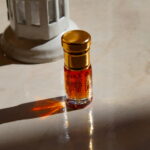
The traditional method of attar production in Kannauj is called “deg bhapka” — a hydro-distillation process using copper stills (deg) and bamboo-connected receivers (bhapka) filled with sandalwood oil. Fresh flowers — rose, jasmine, hina (henna flower), kewra (screwpine), and chameli — are placed in the deg with water, heated over a wood fire, and the steam carrying the flower’s aromatic molecules is channelled into the bhapka, where it condenses and is absorbed by the sandalwood oil base.
This process is slow, labour-intensive, and yields are tiny. It can take hundreds of kilograms of rose petals to produce a single kilogram of ruh gulab. But the result is an attar of extraordinary depth and complexity — a living, evolving fragrance that synthetic alternatives have never fully replicated. The sandalwood oil base gives the attar its longevity (lasting 12–24 hours on skin), while the floral distillate gives it its character.
For Pakistani perfumery, Kannauj’s significance is direct. Many of the attars sold in Pakistan’s bazaars — from Anarkali in Lahore to Saddar in Karachi — trace their origins to Kannauj’s distilleries. The shared cultural and linguistic heritage between Pakistan and northern India means that the attar tradition flows freely across borders. When a Pakistani man applies attar before Jummah, he’s participating in a practice that connects him to Kannauj’s perfumers, the Mughal court, and centuries of aromatic heritage.
5. The Great Attars of the Subcontinent
Several traditional attars hold a special place in South Asian and Pakistani fragrance culture. Each one carries centuries of history and continues to be worn and cherished today.
Ruh Gulab (Rose Essential Oil)
The queen of South Asian attars. Pure rose essential oil, distilled without a sandalwood base, is one of the most expensive natural fragrance materials in the world. Its scent is deep, honeyed, and rich — nothing like the synthetic rose in mass-market perfumes. In Pakistan, ruh gulab is associated with weddings, religious occasions, and gifts of the highest respect. A small vial of genuine ruh gulab from Kannauj can cost tens of thousands of rupees, and it lasts for years if stored properly.
Motia (Jasmine Attar)
Jasmine — specifically Jasminum sambac, known in Pakistan as motia — is the national flower of Pakistan. Motia attar captures the intoxicating, sweet, slightly narcotic scent of fresh jasmine blossoms picked at night, when their fragrance is strongest. Motia garlands are an essential part of Pakistani weddings, Eid celebrations, and religious gatherings. The attar form preserves this scent in a concentrated, wearable format. Lahore’s association with jasmine is so deep that the city is sometimes called the “City of Gardens,” and motia remains one of the most beloved attars in the country.
Shamama and Majmua (Compound Attars)
These are the haute couture of traditional South Asian perfumery. Shamama and majmua are compound attars, meaning they blend dozens of natural ingredients — flowers, herbs, spices, resins, and woods — into a single, complex composition. A traditional shamama can contain 40 to 60 individual ingredients, distilled together over weeks or even months. The result is a warm, deep, multi-layered scent that changes on the skin over hours, much like a modern niche perfume.
These compound attars were the bespoke fragrances of the Mughal and Nawabi courts. Each perfumer had their own secret formulas, passed down through generations. Today, only a handful of families in Kannauj still produce authentic shamama and majmua using traditional methods. These attars are rare, expensive, and represent the pinnacle of South Asian perfumery.
Mitti Attar (The Scent of Rain on Earth)
This is perhaps the most uniquely South Asian attar in existence. Mitti attar captures the scent of sun-baked earth after the first monsoon rain — that distinctive, mineral, earthy fragrance that every Pakistani recognises and loves. It’s produced by distilling baked clay discs over sandalwood oil, and the result is a scent that is simultaneously ancient and immediately familiar.
Anyone who has experienced monsoon season in Lahore, Islamabad, or any Pakistani city knows this smell instinctively. The fact that perfumers figured out how to capture it in a bottle — centuries ago, using nothing but clay, fire, water, and sandalwood — is one of the most remarkable achievements in fragrance history. No synthetic molecule has ever replicated mitti attar convincingly. It remains a purely artisanal product, tied completely to the subcontinent’s landscape and climate.
Oud (Agarwood Oil)
While oud’s origins lie in the forests of Southeast Asia, its cultural home is shared between the Arab world and South Asia. Oud has been traded across the Indian Ocean for centuries, and its use in the subcontinent predates the Mughal period. In Pakistan, oud is the prestige attar — expensive, complex, and deeply associated with wealth, piety, and special occasions. A high-quality Pakistani or Hindi oud has a rich, earthy, slightly smoky character distinct from the sweeter, more barnyard-like profile of some Middle Eastern ouds. Pakistani men who apply oud before Jummah are continuing a tradition that stretches back at least to the 13th century.
6. The Sufi Connection: Fragrance as Spiritual Language
In Pakistan’s cultural landscape, Sufism has played a profound role in shaping how fragrance is understood and used. The great Sufi shrines — the dargahs of Data Darbar in Lahore, Lal Shahbaz Qalandar in Sehwan, and Shah Abdul Latif Bhittai in Bhit Shah — are environments saturated with incense, rose water, and fragrant offerings. Fragrance in this context is not a cosmetic choice. It is a form of spiritual communication.
The Sufi tradition holds that beautiful scent is a bridge between the physical and spiritual worlds. Classical Urdu and Persian poetry — including the work of Rumi, Hafiz, and the great Pakistani poets Allama Iqbal and Faiz Ahmed Faiz — is saturated with fragrance imagery. The scent of roses, the smoke of burning oud, the fragrance of the beloved’s hair — these are recurring metaphors for spiritual longing and divine proximity.
This poetic and spiritual tradition gives fragrance in Pakistan a depth that goes beyond personal grooming. When a Pakistani woman selects a perfume for a special occasion, or when a man applies attar before Friday prayers, there is often an unconscious awareness of this deeper dimension — the sense that fragrance is not just about smelling good, but about presenting oneself with care and intention.
7. The Colonial Disruption and the Survival of Tradition
The British colonial period (1857–1947) brought significant changes to South Asian fragrance culture. The decline of the Mughal and Nawabi courts removed the primary institutional patrons of traditional perfumery. British-educated elites began adopting European toiletries and fragrances, and European perfume houses — Guerlain, Coty, and later Chanel — began reaching South Asian markets through imports.
Traditional attar production in Kannauj declined without court patronage, though it never disappeared entirely. The religious and wedding contexts proved resilient — no colonial influence could dislodge the practice of applying attar before Jummah or scenting a bride before her wedding. These were practices tied to faith and family, and they survived where purely court-driven fashions did not.
Partition in 1947 created Pakistan as a separate nation, but the fragrance culture didn’t divide along the border. The attar tradition, the preference for oud and rose, the practice of applying fragrance on clothes and in the beard — all of these continued seamlessly on both sides, because they were rooted in shared religion, shared language, and shared centuries of cultural practice.
8. The Legacy in Modern Pakistani Fragrance Culture
Today’s Pakistani fragrance market sits at the intersection of its traditional heritage and the global modern perfumery industry. Understanding why the market looks the way it does requires understanding the history behind it.
First, the Pakistani preference for rich, heavy, long-lasting fragrances is not a trend or a fashion — it’s the continuation of a taste formed over a thousand years. A culture that grew up wearing oud, shamama, and ruh gulab will naturally gravitate toward modern perfumes that carry those same qualities: depth, warmth, longevity, and sillage.
Second, the importance of fabric application in Pakistani fragrance culture has deep historical roots. Traditional attars were applied directly to clothes as well as skin — to the collar of a sherwani, to the edge of a dupatta, to the folds of a pashmina. Today’s Pakistani habit of spraying perfume on clothes rather than skin isn’t a deviation from “proper” fragrance use. It’s a continuation of a tradition that’s older than most European perfume houses.
Third, the association between fragrance and special occasions — weddings, Eid, religious events — means that Pakistanis invest more emotionally and financially in fragrance for these moments than most Western consumers do. A bottle of perfume bought for a daughter’s wedding isn’t just a cosmetic product. It’s a statement, a gift, and a memory.
Fourth, the association between fragrance and spiritual life. Applying attar before prayer, burning bakhoor during Quran recitation, scenting the masjid — these practices elevate fragrance from a cosmetic choice to an act of devotion. This spiritual dimension gives fragrance a significance in Pakistani culture that goes beyond personal grooming or fashion.
9. Timeline: Fragrance in South Asian History
Period | Development | Lasting Impact |
|---|---|---|
3300–1300 BCE | Indus Valley Civilisation uses aromatic plants; early distillation evidence | Oldest known perfumery in South Asia |
1500–500 BCE | Vedic texts reference sandalwood, camphor, saffron, and vetiver | Fragrance embedded in religion and medicine |
7th–12th Century | Arab traders bring oud, frankincense, and myrrh; Islam spreads to subcontinent | Attar tradition takes root; spiritual significance of fragrance established |
13th–15th Century | Delhi Sultanate era; Kannauj emerges as attar production centre | Professional perfumery industry develops |
1526–1857 | Mughal Empire: golden age of court perfumery; ruh gulab, shamama, mitti attar | South Asian fragrance culture reaches its peak |
1857–1947 | British colonial period; European perfumes introduced; court patronage declines | Attar tradition survives through religion and weddings |
1947–Present | Partition; modern spray perfumes arrive; traditional and modern markets coexist | Pakistani preference for rich, long-lasting scents continues |
10. What This Means for You
You might be wondering why any of this history matters when you’re deciding which perfume to buy next. It matters because your fragrance preferences didn’t come from nowhere. When you instinctively reach for a rich oud-based scent over a light citrus cologne, you’re expressing a preference that was shaped by a thousand years of cultural inheritance. When you apply attar before Jummah, you’re participating in a practice that connects you to the Mughal court, to the Sufi saints, to generations of South Asian Muslims who understood fragrance as both personal expression and spiritual devotion.
Understanding this history also explains why certain modern perfumery trends work so well in Pakistan. The current global popularity of oud-based fragrances, amber accords, and long-lasting musky compositions isn’t a trend for us — it’s a homecoming. The Western fragrance world is only now discovering what South Asian and Middle Eastern cultures have valued for centuries.
It also explains the unique advantage that Pakistani and South Asian perfumers have in the modern market. We didn’t inherit our fragrance culture from European brands. We have our own tradition — older, in many ways richer, and perfectly suited to our climate, our occasions, and our aesthetic. Modern Pakistani perfumery doesn’t need to imitate Western perfumery. It can build on a foundation that’s already world-class.
Final Thoughts
The next time you spray your perfume, remember that you’re part of a story that stretches back thousands of years. The sandalwood in your base notes has been used in the subcontinent since the Vedic period. The rose in your heart notes is the same flower that Nur Jahan distilled in the Mughal gardens. The oud in your evening fragrance has been traded along Indian Ocean routes for over a millennium. And the practice of applying fragrance on your clothes before stepping out is not a modern trick — it’s a South Asian tradition that predates every Western perfume house in existence.
Pakistan’s fragrance heritage is not a footnote in the global perfume story. It’s one of the main chapters. And the more you understand it, the more you’ll appreciate not just the perfume on your skin, but the centuries of art, science, culture, and devotion that put it there.