What Makes an Inspired Perfume a Good Perfume?

Let’s be honest about something: the inspired perfume market in Pakistan is massive, and it’s not going anywhere. Millions of people who love the scent profiles of international designer and niche fragrances — but who cannot justify spending Rs 20,000-50,000 on a single bottle — turn to inspired alternatives. And there’s absolutely nothing wrong with that. The concept of creating fragrances inspired by popular scent profiles is as old as perfumery itself. Even the most prestigious French perfume houses have spent centuries borrowing ideas, reinterpreting accords, and building on each other’s work.
But here’s where the conversation gets important: not all inspired perfumes are created equal. The gap between a well-made inspired fragrance and a cheap knockoff is enormous — not just in how they smell, but in what’s actually inside the bottle, how they perform on your skin, and whether they’re even safe to wear. A good inspired perfume can genuinely rival or even outperform the original in certain conditions. A bad one can smell synthetic, fade in thirty minutes, irritate your skin, and stain your clothes.
This blog is your guide to understanding the difference. We’ll break down what makes a well-crafted inspired perfume worth your money, what the red flags of a cheap imitation look like, and how to evaluate quality before and after you buy. If you’re going to spend your hard-earned rupees on an inspired fragrance — and most of us will — you deserve to know what separates the excellent from the terrible.
1. First, Let's Define What 'Inspired' Actually Means
An inspired perfume is a fragrance that takes the scent profile of a well-known perfume as its starting point and recreates that profile using the perfumer’s own formulation. It’s not a counterfeit — it doesn’t claim to be the original brand, it doesn’t use the original’s name or packaging, and it doesn’t pretend to be something it’s not. It’s a fragrance that says: if you love the way Creed Aventus smells, you’ll love this too.
This is fundamentally different from a fake or counterfeit, which copies the original’s branding, packaging, and name to deceive you into thinking you’re buying the real thing. Fakes are illegal, unethical, and often dangerous. Inspired fragrances are a legitimate product category — but like any category, quality varies wildly.
The key thing to understand is that inspired perfumery is an act of formulation, not photocopying. A good inspired perfume house doesn’t just buy a cheap fragrance oil that vaguely smells like the original and dilute it in alcohol. They study the original’s scent profile, identify the key aromachemicals and accords that define its character, and then build their own formulation from scratch using quality ingredients at appropriate concentrations. The result captures the spirit and feel of the original while being its own composition.
This distinction matters because the quality of the formulation process is what separates a Rs 4,000 inspired perfume that performs like a Rs 25,000 original from an Rs 800 knockoff that smells like air freshener after twenty minutes.
2. What Makes a Good Inspired Perfume: The Quality Markers
A well-made inspired perfume isn’t just about smelling similar to the original. It’s about delivering a complete fragrance experience — from the moment you spray to the last traces of the drydown, twelve hours later. Here’s what separates a quality inspired fragrance from the rest.
High Aromatic Concentration
This is the single most important technical factor. The concentration of aromatic material in the fragrance — the actual perfume oils, aromachemicals, and accords dissolved in the alcohol base — determines how strong the scent is, how far it projects, and how long it lasts. A well-made inspired perfume should be formulated at Eau de Parfum (15-20%) or Extrait de Parfum (20%+) concentration levels.
Many cheap inspired perfumes are formulated at 5-8% concentration — barely Eau de Toilette level — to cut costs, because aromatic ingredients are the most expensive part of any fragrance. They compensate by front-loading cheap top notes that smell strong on initial spray but evaporate within the first hour. A good inspired perfume doesn’t need this trick. At proper concentration, the scent has substance from the first spray to the last, with a full development through top, heart, and base notes.
When an inspired perfume is formulated at 25-31%+ aromatic concentration — true Extrait de Parfum territory — you’re getting a scent density that often exceeds the original designer fragrance, which is frequently sold as an EDT at 8-12%. This is one of the genuine advantages of the inspired market: a good house can offer you a higher concentration than the original at a fraction of the price, because they’re not carrying the brand’s marketing and retail overhead.
Quality Aromachemicals and Ingredients
Not all aromachemicals are the same. The same molecule — Ambroxan, Hedione, Iso E Super — is available in different grades from different suppliers, and the quality difference is noticeable. Premium-grade Ambroxan from a reputable supplier like Firmenich or Givaudan smells smoother, richer, and more refined than a cheap generic version from an unknown source. The same is true for every raw material in a fragrance formula.
Good inspired houses source their fragrance oils from established, internationally certified suppliers. When a brand tells you their oils come from Swiss, French, or EU-certified suppliers and can name them, that’s a meaningful transparency signal. It’s a verifiable supply chain claim that speaks to formulation integrity.
High-Purity Alcohol Base
The alcohol in a perfume isn’t just a carrier — it affects how the fragrance smells, how it projects, and how it interacts with skin. High-quality perfumery uses food-grade ethanol at 96% purity or higher. Low-grade industrial or denatured alcohols can introduce harsh, solvent-like notes that interfere with the fragrance composition, cause skin irritation, and make the opening smell sharp or chemical.
A well-made inspired perfume should have a clean, smooth spray with the alcohol disappearing within 30-60 seconds, leaving only the fragrance behind. If the alcohol smell lingers for several minutes after spraying, it’s usually a sign of a lower-grade carrier.
Proper Maceration Time
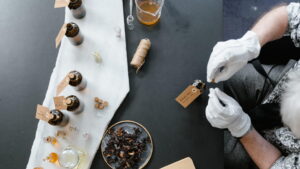
After a perfume is mixed, it needs time to mature. This process, called maceration, allows the aromachemicals, fragrance oils, and alcohol to fully integrate and harmonise. A well-made perfume is macerated for at least two to four weeks before bottling. During this time, the scent smooths out, harsh edges soften, and the overall composition becomes more cohesive and rounded.
Cheap operations skip maceration entirely or reduce it to a day or two because time is money. The result is a fragrance that smells disjointed — you can pick out individual ingredients rather than experiencing a blended whole. It’s the olfactory equivalent of hearing individual instruments warming up versus hearing a full orchestra play a composed piece. Maceration is invisible to the consumer, but its absence is absolutely noticeable in the finished product.
3. Red Flags of a Badly Made Inspired Perfume
Now that you know what quality looks like, here are the warning signs that an inspired perfume is poorly made, cut-corner, or outright bad. Some of these are detectable before you buy. Others only become apparent after you’ve sprayed it on.
Red Flag #1: It’s Suspiciously Cheap
Price isn’t always a perfect indicator of quality, but it’s a strong signal. Quality aromachemicals, proper concentration levels, good alcohol, and adequate maceration time all cost money. If an inspired perfume is being sold for Rs 500-800 for a 50ml bottle, the maths simply don’t add up. The raw material cost alone for a properly formulated Extrait exceeds that price point. At that price, you’re getting a low-concentration mixture of cheap fragrance oil in low-grade solvent, and no amount of marketing can change the chemistry.
A good inspired Extrait de Parfum, properly formulated with quality ingredients at 25-31%+ concentration, realistically costs Rs 3,500-6,000 at the consumer level. Below that range, compromises are being made somewhere — either in concentration, ingredient quality, or both.
Red Flag #2: Overpowering Opening That Fades Fast
This is the classic signature of a front-loaded formula. You spray it, and for the first fifteen to twenty minutes, the scent is loud, sharp, and unmissable. Then within an hour, it’s gone — or worse, it collapses into a thin, synthetic, plasticky residue that smells nothing like the bold opening.
What’s happening is that the formula is loaded with cheap, volatile top-note materials that evaporate quickly. There’s no substantial heart or base underneath to sustain the scent. It’s the fragrance equivalent of a firework — spectacular for a moment, then nothing. A well-made inspired perfume opens strong but also sustains — the heart notes emerge naturally as the top notes settle, and the base notes carry the scent for eight to twelve hours.
Red Flag #3: It Smells Chemical or Gives You a Headache
A properly formulated perfume, even one made entirely from synthetic aromachemicals, should not smell harsh or unpleasant. Modern aromachemicals are sophisticated molecules designed to smell beautiful. When a perfume smells harsh, sharp, plasticky, or gives you a headache within minutes, it typically indicates low-grade ingredients, poor-quality alcohol, no maceration, or over-concentration of a cheap ingredient to compensate for the absence of more expensive ones.
Some people assume all synthetic perfumes smell chemical. That’s not true. The vast majority of all perfumes — including the most expensive niche houses — are primarily built from synthetic aromachemicals. The difference is in the quality grade. Premium Hedione smells like jasmine-kissed air. Low-grade jasmine fragrance oil smells like bathroom cleaner. The molecule matters, but so does the quality tier.
Red Flag #4: It Stains Your Clothes
A well-made perfume should not leave visible stains on light-coloured fabric. If you spray your perfume on a white kurta and it leaves a yellow or brown spot, something is wrong with the formulation. This is usually caused by excess dye, improperly processed fragrance oils, or non-standard additives that oxidise on contact with fabric.
In Pakistan, where kurta shalwar and light-coloured formal wear are everyday clothing, a staining perfume is functionally useless for fabric application — which is exactly where most Pakistanis apply their fragrance. A staining formula is a clear sign the brand hasn’t properly tested or refined its product.
Red Flag #5: The Scent Changes Batch to Batch
When you buy a second bottle of the same fragrance, it should smell the same as the first. If every batch smells noticeably different — one sweeter, the next harsher, the third weaker — the production process lacks precision. The formulation isn’t being measured accurately, the ingredients aren’t standardised, or different sources are being used interchangeably without quality control.
Good inspired perfume houses weigh their ingredients with precision, use consistent suppliers, and test each batch against a reference standard before bottling. This is the difference between a brand you can trust and one that’s gambling with every bottle.
Red Flag #6: No Development Over Time
A well-made fragrance has a progression: the opening (top notes, first 15-30 minutes), the heart (1-4 hours), and the drydown (base notes, 4+ hours). If an inspired perfume smells exactly the same at minute one and hour six, it’s likely a very simple composition without structural depth — a single fragrance oil diluted in alcohol rather than a properly engineered composition with real top-heart-base architecture.
Red Flag #7: The Seller Can’t Answer Basic Questions
When you ask an inspired perfume seller basic questions — What’s the concentration level? What type of alcohol is used? How long is the maceration period? What supplier are the fragrance oils from? — and they can’t answer or give vague, evasive responses, treat it as a red flag. A brand that’s proud of its formulation will talk about it openly. Brands that hide behind vague claims like ‘premium imported oils’ or ‘French fragrance’ without specifics are usually concealing a lack of substance.
4. Pakistan-Specific Considerations
Beyond the universal quality markers, several factors specific to Pakistan’s market and climate make certain quality questions even more important here than elsewhere.
Heat Performance is Non-Negotiable
An inspired perfume that performs well in a European climate-controlled room may fall apart in Lahore’s summer heat. A good inspired house formulating for the Pakistani market should test their fragrances in local conditions — in actual Pakistani heat — not just in a 20 degree laboratory. Ask whether the brand has tested longevity on Pakistani skin in summer conditions. If they have, they’ll give you specific hours. If they haven’t, the performance claims are educated guesses at best.
Fabric Safety Matters More Here
Because most Pakistanis apply perfume on clothes — on kurta fabric, on dupattas, on shawls — fabric safety is a bigger deal here than in markets where skin-only application is the norm. Ask whether the brand has tested its formulation for fabric staining, particularly on white and light cotton. A quality brand will have done this.
IFRA Compliance and Skin Safety
Aromachemicals are regulated by the International Fragrance Association (IFRA), which sets safe concentration limits for individual ingredients based on toxicological research. A brand using quality, certified ingredients from reputable suppliers will automatically be working within safe concentration ranges. Always ask whether the fragrance oils used are from IFRA-compliant suppliers.
5. What the Aks Royale Standard Looks Like in Practice
Since this guide is about knowing what to demand from any inspired perfume — including ours — here’s how Aks Royale approaches each of the quality markers above.
Every fragrance in the Aks Royale lineup is formulated at approximately 31% total aromatic concentration — well into Extrait de Parfum territory. The formula combines approximately 23% perfume oil with a proprietary additive blend that contributes an additional ~8%, for a total aromatic content around 31%. This is not a marketing claim; it’s a specific, verifiable number.
Our fragrance oils are sourced from internationally certified suppliers including LUZI (Switzerland) and materials from Firmenich and Givaudan supply chains. These are the same supply chains used by major fragrance houses worldwide. The specific supplier codes for each fragrance oil are documented.
Our formulations include a custom Heat-Smart Additive Blend — a proprietary combination of Hedione, Iso E Super, Galaxolide, Ethylene Brassylate, and Ambroxan — specifically calibrated for Pakistan’s climate. This additive system was developed after testing showed that standard formulations lose longevity significantly in Pakistani summer heat. All batches macerate for a minimum of three weeks before bottling, and every batch is tested against a reference standard before shipping.
We don’t use dyes. Our juice is either naturally coloured from the fragrance oils or clear — never artificially tinted to look more premium. These are the minimum standards we believe every consumer in Pakistan deserves from any inspired perfume they buy.
6. How to Evaluate an Inspired Perfume Before You Buy
Check the concentration claim. If it says Extrait de Parfum, ask for the specific percentage. If the seller cannot tell you the exact aromatic concentration, treat any concentration claims with scepticism.
Ask about the ingredient source. Where do the fragrance oils come from? Can they name the supplier? EU-certified suppliers from Switzerland, France, or Germany are the gold standard.
Test on skin, not a strip. Paper tester strips only show you the opening. Apply on your wrist, wait 30 minutes for the heart to develop, then another hour for the base. The two-hour mark is where quality separates from pretension. Any perfume can smell good for fifteen minutes — the question is what happens after that.
Test on light fabric. Spray a small amount on the inside of your shirt collar or a corner of white tissue. Check for staining after it dries. If there’s a mark, walk away.
Ask questions. Ask about concentration, ingredient sourcing, maceration time, and the return or exchange policy. A confident, quality-focused brand will welcome these questions. An evasive seller is telling you everything you need to know.
7. Quick Reference: Good vs Bad Inspired Perfume
Quality Marker | Good Inspired Perfume | Cheap Knockoff |
|---|---|---|
Concentration | 25-31%+ Extrait level; stated transparently | 5-8% EDT level; often unlisted |
Ingredient source | Premium suppliers (LUZI, Firmenich, Givaudan) | Unknown generic oils, unverified sourcing |
Alcohol base | High-purity perfumery alcohol (96%+) | Low-grade industrial alcohol |
Maceration | 2-4 weeks minimum before bottling | Days or less; sometimes none |
Opening | Clean, smooth; alcohol gone in 30-60 seconds | Harsh blast; chemical or solvent note |
Development | Clear progression: top to heart to base | Flat or collapses within an hour |
Longevity | 8-12+ hours on skin; 24+ hours on fabric | 30 min-2 hours, then goneGrowing rapidly — actively seeks independent brands
|
Staining | No staining on light fabric | Yellow/brown stains on clothes |
Consistency | Same scent batch to batch | Varies noticeably between batches |
Transparency | Brand answers formulation questions openly | Evasive or vague; hides behind ‘premium oils’ |
Price point | Rs 3,500-6,000 for 50ml Extrait | Rs 500-1,500; too cheap to be real |
8. The Bottom Line: What Your Money Should Buy
When you buy a well-made inspired perfume at a fair price, here’s the minimum you should expect: a smooth, pleasant opening with no harsh chemical blast; a clearly defined heart that emerges within 30-60 minutes; a warm, lasting base that carries the scent for 8-12 hours on skin and 24+ hours on fabric; no staining on light clothes; consistency between bottles; and transparent information about what you’re buying.
If a brand delivers all of this at Rs 3,500-6,000 for a 50ml Extrait, you’re getting extraordinary value. The fact that it’s inspired by a more expensive original doesn’t diminish its quality — it demonstrates that quality perfumery doesn’t have to cost a fortune.
And if you’re holding a bottle that cost Rs 600, smells amazing for ten minutes, and then vanishes — now you know why. Good perfume takes good ingredients, good formulation, good maceration, and good faith. There are no shortcuts.
Final Thoughts
The inspired perfume market in Pakistan offers incredible opportunity for consumers who know what to look for. You can build a world-class fragrance wardrobe at a fraction of international designer prices, with performance that’s not just comparable but often superior in our climate and conditions. The key is education — understanding what separates quality from cheapness, knowing the red flags, and demanding transparency from the brands you support.
A good inspired perfume respects both the art of the original and the intelligence of its consumer. It says: we know you love this scent profile, and we’ve invested the skill, ingredients, and care to deliver it to you at a price that makes sense for your life. That’s not a compromise. That’s a promise. And the brands that keep that promise are the ones that deserve your loyalty.