Where and How to Apply Perfume For Maximum Impact

Pulse Points, Clothing, Distance, Common Mistakes & the Pakistani Context
You could own the finest perfume in the world, but if you’re applying it wrong, you’re wasting it. Application isn’t just about where you spray — it’s about how far you hold the bottle, how many sprays you use, what surface you’re spraying on, and what you do (or don’t do) immediately after. Small details make the difference between a fragrance that turns heads all day and one that disappears before you’ve left the house.
In Pakistan, application matters even more. Our climate accelerates evaporation, our cultural dress offers unique opportunities for fabric application, and the way many of us wear perfume — a blend of skin and clothes — is actually more effective than the Western skin-only approach, if done correctly.
This guide covers every aspect of perfume application in detail: the science behind pulse points, the technique of spraying, the differences between skin and clothing application, how many sprays you actually need, and the most common mistakes that silently ruin your fragrance experience.
1. The Science Behind Pulse Points
You’ve probably heard that you should apply perfume to your “pulse points.” But why? What makes these spots special, and does it actually make a difference?
Pulse points are areas on your body where blood vessels run close to the surface of the skin. Because blood is warm, these spots are slightly warmer than the rest of your body. That warmth acts as a natural diffuser — it gently heats the fragrance molecules sitting on the skin, causing them to evaporate into the air around you at a steady, controlled rate. This is what perfumers call “projection” — how far your scent radiates from your body.
Without that warmth, perfume molecules just sit on the skin surface and release their scent very slowly. You’d smell it if you brought your wrist right up to your nose, but nobody around you would notice. Pulse points provide the gentle heat engine that pushes the scent outward, creating the sillage — the invisible trail of fragrance you leave behind as you move through a room.
2. The Pulse Point Map: Where to Apply and Why
Not all pulse points are equal. Each one has its own characteristics — how warm it gets, how much it sweats, how exposed it is to air, and how close it is to other people’s noses. Here’s a detailed breakdown of every major application point and how it performs in Pakistan’s climate.
Inner Wrists — The Classic
The inner wrist is the most popular application point worldwide, and for good reason. It’s warm, it’s accessible, and you can easily smell your fragrance throughout the day by bringing your wrist to your nose. In Pakistan’s heat, the wrists project fragrance effectively because they’re almost always exposed, whether you’re wearing a kurta, a dress shirt, or a casual t-shirt.
The downside is that wrists take a beating during the day. Washing hands (especially for wudu, which most Pakistanis perform multiple times daily) will strip fragrance from the wrists. If you’re someone who makes wudu frequently, your wrist application will fade faster than other points. In this case, consider the wrists as your “morning boost” and rely on other points and clothing for lasting scent.
Sides of the Neck — The Power Zone
The sides of the neck, just below the jawline, are arguably the most effective pulse point for perfume in social situations. When you’re talking to someone face-to-face, greeting someone, or sitting close to people at a dinner or gathering, the neck is at nose level. Fragrance applied here reaches other people more directly than almost any other point.
In Pakistan’s context, the neck is also partially protected by clothing — the collar of a kurta, the dupatta draped around the shoulders, or the neckline of a kameez. This partial coverage actually helps, because it slows down evaporation while still allowing the scent to project upward. One spray on each side of the neck is one of the most efficient applications you can make.
Behind the Ears — The Intimate Spot
The area behind the ears is one of the warmest pulse points on the body, and it’s naturally sheltered from wind and direct sunlight. Fragrance applied here lasts well and projects in a very intimate zone — someone sitting next to you, hugging you, or leaning in to talk will catch this scent clearly.
This point is especially effective for close-contact situations: family gatherings, seated dinners, or the kind of shoulder-to-shoulder socialising that’s common at Pakistani events. It’s also one of the few spots that doesn’t get heavily affected by sweat, even in summer.
Inner Elbows — The Underrated Point
The crook of your inner elbow is a pulse point that many people overlook. It’s warm, it’s protected when your arm is at rest, and when you move your arms — gesturing while talking, reaching for something, embracing someone — it releases a burst of fragrance into the air. It’s a dynamic application point that rewards natural movement.
In Pakistani summer, the inner elbows can get sweaty, which reduces effectiveness. This point works best in winter or in air-conditioned environments. In summer, skip this one and focus on the neck and wrists.
Behind the Knees — The Scent Riser
This is a classic technique from old-school perfumery. The idea is that heat rises, so fragrance applied at a low point on the body will drift upward throughout the day, creating a subtle, all-over scent cloud. The area behind the knees is warm and usually covered by clothing, which protects the fragrance from direct sun and wind.
In practice, this works best if you’re wearing loose clothing that allows air to circulate — which is exactly what most Pakistanis wear in summer. Shalwar kameez, whether for men or women, creates a natural airflow from the knees upward. A spray behind each knee can create a gentle, ambient scent that people notice without being able to pinpoint where it’s coming from.
Chest — With Caution
The chest is a popular application point because it’s where many people instinctively spray. However, the chest is also one of the sweatiest areas on the body, especially in Pakistani heat. Spraying directly on chest skin in summer means the fragrance is competing with sweat, which dilutes and alters the scent.
The better approach for the chest area is to spray on the clothing covering your chest rather than the skin underneath. A spray on the front of your kurta or the collar area of your shirt gives you the same projection zone but with fabric longevity instead of skin evaporation. If you do spray on chest skin, do it in winter or when you’ll be in air-conditioned spaces all day.
Hair — The Secret Weapon
Hair is an exceptional fragrance carrier. The fibres absorb and hold scent molecules remarkably well, and every time you move your head, you release a fresh wave of fragrance. For women who wear their hair uncovered, a light mist from a distance onto the hair can carry scent beautifully throughout the day.
However, there’s an important caution: most perfumes contain alcohol, which can dry out hair over time. If you want to apply perfume to your hair regularly, spray it on a brush or comb first and then run that through your hair, rather than spraying directly. Alternatively, if your brand makes a hair mist version, that’s specifically formulated to be gentler on hair fibres.
For men with beards — increasingly popular among young Pakistani men — the beard acts exactly like hair in holding fragrance. A single spray or dab of attar on the beard can hold scent for hours, and because the beard sits right below the nose, you’ll enjoy the scent personally while also projecting it to people around you.
3. Clothing Application: The Pakistani Edge
In Western perfume culture, applying fragrance on skin is considered the “proper” way, and clothing application is often treated as secondary. In Pakistan, it’s the opposite — many people spray primarily on clothes, and it’s actually one of the smartest things you can do for longevity.
Why Fabric Outperforms Skin in Heat
Fabric doesn’t sweat, doesn’t have a pH that alters fragrance molecules, and doesn’t generate as much body heat. In Pakistan’s 45°C summers, skin application means fighting against evaporation, sweat, and your body’s natural chemistry simultaneously. Fabric sidesteps all three problems. A perfume sprayed on cotton, linen, or khaddar simply sits in the fibres and releases slowly over hours.
The trade-off is that you lose the evolving nature of the fragrance. On skin, a perfume moves through its top, heart, and base stages dynamically. On fabric, it tends to project a more consistent, static version of the heart and base notes. Many people actually prefer this — it’s the reliable, steady scent that Pakistani culture associates with wearing fragrance well.
Best Fabrics for Fragrance in Pakistan
Cotton lawn: The summer staple. Absorbs fragrance beautifully, releases it slowly, and the lightweight weave allows scent to project naturally through the fabric. This is your best everyday fragrance carrier from April to September.
Khaddar/cotton: Slightly heavier than lawn, khaddar holds fragrance even longer. Ideal for transitional weather — October, November, March — when temperatures are warm but not extreme.
Linen: Similar performance to cotton but with slightly better absorption. Linen’s natural texture traps fragrance molecules effectively. Excellent for summer and early autumn.
Wool & pashmina: The winter champions. Wool fibres absorb and retain fragrance for days. A shawl or pashmina sprayed once can carry scent through multiple wearings before it needs refreshing. Ideal for evening events, dinners, and winter outings.
Silk: Beautiful fabric, but tricky with perfume. Silk absorbs scent well, but alcohol-based perfumes can stain silk permanently. If you want to fragrance silk, spray from a greater distance (30cm+) or apply to the underside of the garment where stains won’t show.
Polyester/synthetic: The worst option. Synthetics don’t absorb fragrance properly — the molecules sit on the surface and can create a harsh, alcohol-forward smell, especially in heat. If your outfit is synthetic, stick to skin application.
Where to Spray on Clothes
The most effective spots for clothing application are areas where the fabric moves and creates airflow. For men wearing kurta shalwar, the chest area, the cuffs of the sleeves, and the collar are ideal — movement of the arms and natural air circulation push the scent outward. For women, the front of the kameez, the edges of the dupatta, and the inner folds of a shawl are the best spots.
Avoid spraying heavily in one concentrated spot. Instead, hold the bottle 20–30 centimetres from the fabric and spray in a sweeping motion to distribute the fragrance across a wider area. This creates a more natural, ambient scent rather than a single intense point.
4. Spray Distance and Technique
How far you hold the bottle from your body when spraying makes a genuine difference in how the fragrance distributes and how it performs.
On Skin: 10–15 Centimetres
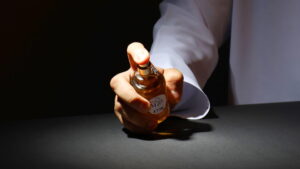
When spraying on skin, hold the bottle approximately 10–15 centimetres (about a hand’s length) from the skin. This distance allows the spray to atomise properly — the perfume breaks into a fine mist that lands evenly across the pulse point. Too close and you get a concentrated wet spot that takes longer to dry and wastes fragrance. Too far and the mist disperses before it reaches your skin.
On Clothes: 20–30 Centimetres
For fabric, increase the distance to 20–30 centimetres. Fabric is more absorbent than skin, so you want a wider spray pattern that covers more surface area. This creates a more natural diffusion and prevents staining. A wider spray on your kurta’s chest area is more effective and more subtle than a concentrated blast at point-blank range.
The Walk-Through Mist — Does It Work?
You’ve probably seen the advice to spray perfume into the air and walk through the mist. While this creates a very light, all-over application, it’s extremely wasteful — most of the fragrance ends up on the floor, not on you. In Pakistan’s heat, where you need every drop to count, this technique doesn’t make practical sense. Direct application to pulse points and clothes is far more efficient and effective.
5. How Many Sprays Do You Actually Need?
This is one of the most debated questions in fragrance, and the answer depends on the concentration, the climate, and the situation. Here’s a practical guide for Pakistan.
Extrait de Parfum (20–40% oil)
Extraits are concentrated and powerful. In Pakistan’s heat, 2–4 sprays total is more than enough. One on each wrist and one on the neck will project well and last all day. Adding a spray on clothes for longevity is optional but effective. Over-spraying an Extrait in summer can overwhelm everyone around you because the heat amplifies projection aggressively.
Eau de Parfum (15–20% oil)
The all-rounder. In summer, 3–5 sprays is the sweet spot — a couple on skin and a couple on clothes. In winter, you can comfortably go up to 5–7 sprays because the cold suppresses projection and you need more to achieve the same sillage.
Eau de Toilette (5–15% oil)
EDTs are lighter by nature and fade faster in heat. If you’re wearing an EDT in Pakistan’s summer (which isn’t ideal but sometimes necessary), apply 4–6 sprays and plan to reapply after a few hours. In winter, 3–5 sprays will carry you through most of the day.
The Situational Factor
Context matters as much as concentration. For a small office with close seating, fewer sprays. Your colleagues don’t want to be engulfed. For an outdoor wedding or a large family gathering, you can spray more generously — the open air and distance between people mean your sillage needs to travel further to be noticed.
A good rule of thumb for Pakistan: if you can still smell your perfume strongly 10 minutes after application, you’ve probably applied enough. If you can’t smell it at all after 10 minutes, add one more spray. Remember that your nose adapts to your own scent quickly — just because you can’t smell it doesn’t mean others can’t.
6. Common Mistakes That Ruin Your Fragrance
Even expensive, high-quality perfumes underperform when applied incorrectly. Here are the most common mistakes, many of which are especially damaging in Pakistan’s climate.
Rubbing Your Wrists Together
This is the number one mistake. Rubbing creates friction, and friction generates heat that breaks down the fragrance’s top notes before they have a chance to develop naturally. The delicate opening of a perfume — the citrus, the green notes, the first burst of freshness — gets destroyed. In Pakistan’s heat, where top notes already evaporate faster, rubbing makes things even worse. Spray, let the perfume land, and leave it alone.
Spraying on Dry, Unprepped Skin
Dry skin is perfume’s enemy. Without moisture, fragrance molecules have nothing to bond with and evaporate rapidly. This is especially relevant during Pakistani winters when cold air and indoor heating dry out the skin, and in summer when air conditioning has the same effect. Always moisturise your pulse points before applying perfume. An unscented lotion or a thin layer of Vaseline creates the ideal base.
Storing Perfume in the Bathroom
Pakistan’s bathrooms get hot and steamy, which degrades perfume over time. Heat, humidity, and light are the three enemies of fragrance stability. If your perfume lives on a bathroom shelf, it’s slowly losing its quality every day. Store your bottles in a cool, dark place — a bedroom drawer or a closet shelf is ideal.
Spraying Too Close
Holding the bottle too close to your skin or clothes creates an overly concentrated application point. The fragrance doesn’t distribute evenly, the alcohol component hits the surface too aggressively, and on fabric, it increases the risk of staining. Maintain that 10–15cm distance for skin and 20–30cm for clothes.
Over-Spraying Because You Can’t Smell It
Olfactory fatigue is real. Your nose stops registering your own scent within 15–20 minutes of application. This doesn’t mean the fragrance has disappeared — it means your brain has adapted to the constant stimulus and stopped sending you the signal. Other people can still smell you clearly. If you keep spraying because you think the perfume has faded, you’re likely drowning the room in fragrance without realising it.
The solution: instead of sniffing your wrist repeatedly, smell the collar of your shirt or ask someone nearby. Fabric gives a more honest reading of how much scent remains.
Spraying Directly on Jewellery or Accessories
Perfume’s alcohol content can tarnish metals, damage pearls, and discolour certain stones. This is particularly relevant for women wearing gold jewellery, which is extremely common at Pakistani gatherings, weddings, and family events. Always apply perfume before putting on jewellery, and avoid spraying near necklaces, earrings, or bracelets.
7. Application by Occasion: A Pakistani Guide
Daily Office or University
Keep it moderate and professional. Two sprays on the wrists and one on the neck is plenty. In a confined office or classroom, heavy projection is inconsiderate. Choose subtle, clean, or fresh fragrances and let them sit close to your body.
Weddings and Formal Events
This is where you go all out. Three to five sprays on pulse points, plus one or two on the collar of your sherwani, kurta, or formal dress. The open spaces, large gatherings, and long hours of a Pakistani wedding demand a fragrance that projects and lasts. Choose bold, rich compositions — oud, amber, deep florals — and layer if you can. Fabric application on formal clothing is highly effective here.
Jummah and the Masjid
One or two applications of attar on the wrists and beard, or a couple of sprays of a refined fragrance on your thobe or kurta, is both respectful and effective. In the close quarters of a masjid, moderation is key.
Hot Outdoor Events
For outdoor events in summer — cricket matches, picnics, outdoor dinners — lean heavily on fabric application. Your skin will sweat the fragrance away within an hour or two, but your clothes will carry it. Apply an extra spray on your clothes compared to your skin, and choose a fragrance with strong base notes that won’t be wiped out by the heat.
8. Quick Reference: Application Guide
Application Point | Projection | Longevity | Best For |
|---|---|---|---|
Inner wrists | Moderate | 3–6 hours (fades with wudu) | Personal scent, morning boost |
Sides of neck | High | 4–8 hours | Social situations, face-to-face |
Behind ears | Low (intimate) | 5–8 hours | Close contact, family gatherings |
Inner elbows | Medium (dynamic) | 3–6 hours | Winter, air-conditioned spaces |
Behind knees | Subtle, rising | 4–7 hours | All-over ambient scent, loose clothing |
Chest (on clothes) | High | 8–12+ hours | Everyday wear, hot weather |
Hair / beard | Medium | 6–10 hours | All-day carry, personal enjoyment |
Dupatta / shawl | High (movement) | 12–48+ hours | Events, winter, long-lasting trail |
Final Thoughts
Perfume application is the bridge between buying a great fragrance and actually experiencing it. You can own the best bottle on the shelf, but if you’re rubbing your wrists, spraying on dry skin, and storing the bottle in a hot bathroom, you’re undermining everything the perfumer designed.
In Pakistan, where our climate, our clothing, and our culture create a unique fragrance environment, mastering application is especially valuable. The fact that we naturally wear loose, breathable clothing like shalwar kameez gives us an advantage in fabric application that most Western fragrance guides completely overlook. The tradition of attar on the beard, itr on the collar, perfume on the dupatta — these aren’t just cultural habits, they’re scientifically sound techniques.
Apply smart, apply to both skin and fabric, respect the climate, and your fragrance will do exactly what it was designed to do: make you memorable.